

A car can come back from the body shop straight, matched and safe, and still be worth less than it was the week before the wreck. That gap has a name. A diminished value claim in Texas asks for the drop in market value after a collision repair, and the state’s insurance regulator is clear about who may owe it and who doesn’t. If another driver caused the crash, their insurer is the one to ask. Your own policy usually isn’t. On a late-model Audi, BMW or Porsche, the proof starts at the collision shop. Ames Collision Center repairs European makes on West Mockingbird Lane, and the records from that repair are part of your case.
Quick Summary: Key Takeaways
- Diminished value is lost market value: the car is repaired, but a buyer will still pay less because it was wrecked.
- The other driver’s insurer is the target: Texas regulators say your own insurer isn’t obligated to pay it after a complete repair.
- Two years is the legal outer limit: Texas gives you two years to sue over damage to your property.
- Keep every repair record: the estimate, photos and final invoice from the body shop all document the damage.
What Diminished Value Means After a Collision Repair
Diminished value after an accident is the difference between what your car was worth before the damage and what it’s worth after a complete repair. The Texas Department of Insurance (TDI) described it in Bulletin B-0027-00, dated April 6, 2000, as the claim that a vehicle’s market value after full repair is lower than its market value before.
The repair can be perfect. A trade-in appraiser who sees a replaced front end on a two-year-old Q5 will price that history in, even when the panel gaps are perfect. The gap between the two prices is what the claim asks someone to pay.
A Diminished Value Claim in Texas Goes to the At-Fault Driver’s Insurer
TDI‘s position is that an insurer is not obligated to pay its own policyholder for diminished value when the car has been completely repaired, because the standard policy language doesn’t mention it. Your collision coverage pays to fix the car. The resale loss stays yours.
The other driver’s insurer is different. The same bulletin says an insurer may be obligated to pay a third-party claimant for lost market value regardless of how complete the repair was. Uninsured and underinsured motorist coverage on your own policy may pay it too. Who caused the crash matters.
Weather claims rarely fit. Hail is damage from something other than a collision, so it’s paid under the comprehensive coverage on your own policy, and the bulletin’s first-party position applies there.
Start the Claim the Way TDI Lays It Out
Begin at the scene. TDI’s consumer guidance says to photograph the other driver’s insurance card and license, then file a claim with that driver’s insurer once you’re home and let your own company know. If police responded, get the report and send a copy to the other insurer.
Some insurers push back. You don’t have a contract with the other driver’s company, so it may dispute fault, stall, or say its driver’s limits are too low, and TDI suggests asking for any refusal in detail and in writing. If it still won’t pay, a complaint to TDI requires the company to explain its decision, and legal help is the next step after that.
Your Repair File Documents the Damage
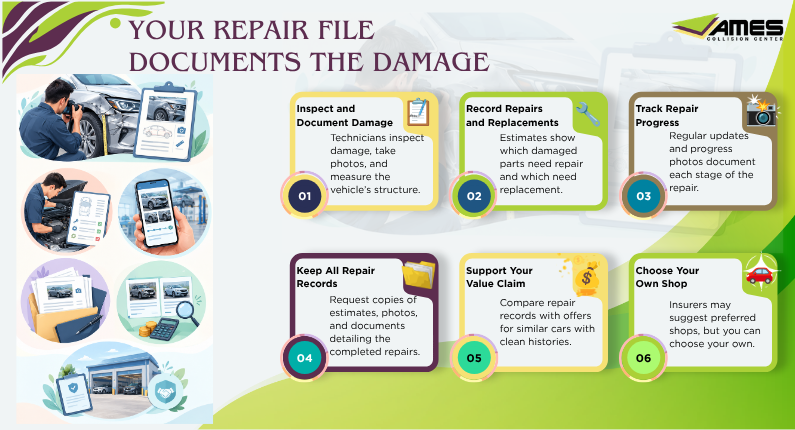
The repair file is the record of what was hit and what was replaced. At Ames, technicians inspect the damaged area and underneath it, take photos and measure the structure, then write an estimate and explain which parts need repair and which need replacing. Updates and progress photos follow during the work.
Ask for copies of everything. A replaced door or a measured frame is hard to wave away when it’s written into the shop’s own estimate. Pair those pages with a couple of written trade-in offers or listings for the same model with a clean history, and the gap starts to look like a number instead of a feeling.
The shop is your choice. TDI’s auto insurance guide notes that an insurer may hand you a list of preferred shops but can’t require you to use one.
Two Years Is the Outer Limit, and the Holidays Eat Time
Section 16.003 of the Texas Civil Practice and Remedies Code requires a suit for injury to someone’s property to be brought within two years of the day the cause of action accrues. That’s the courtroom deadline. The insurance conversation should start long before it.
Timing works against you in winter. Between Thanksgiving and New Year’s, I-35E, I-30 and the Dallas North Tollway fill with stop-and-go traffic, and rear-end fender benders in that traffic are the classic result. Cars from those wrecks come back from the shop in December and January, when nobody wants to chase an adjuster. Start the claim early. Even a bumper-only repair belongs in that conversation.
Frequently Asked Questions
Q: Can I file a diminished value claim with my own insurance in Texas?
A: Usually not. TDI’s position is that your insurer isn’t obligated to pay diminished value after a complete repair. The exception is uninsured or underinsured motorist coverage on your own policy, which may pay it when the at-fault driver has no insurance or not enough.
Q: How long do I have to file a diminished value claim in Texas?
A: The legal limit for suing over property damage is two years from when the claim arises. Don’t wait that long.
Q: Do I get diminished value if the car was repaired perfectly?
A: You can. TDI says the at-fault driver’s insurer may owe a third-party claimant for lost market value regardless of how complete the repair was.
Q: What proof do I need for a diminished value claim?
A: The police report, the repair estimate and invoice, photos of the damage, and evidence of what the car would sell for now compared with a clean-history example.
Get the Repair Documented From Day One
Bring the claim number, the police report if there is one, and the other driver’s insurance details to the first visit. Estimates don’t need an appointment at 1912 W Mockingbird Ln, Dallas, TX 75235, though the scheduling page on amescollisioncenter.com lets you pick a time that suits your week. Keep every page you’re given.
